
CuratorSpace Artist Bursary #32: Darren Calder
Darren Calder is a contemporary tapestry weaver based in Brighton, UK. His practice brings together questions of identity, history, and language, often through unconventional materials. He sees weaving as a way of thinking as much as making.
Darren first encountered weaving while studying Decorative Arts at Camberwell Art School in the early 1990s. Although he initially wanted to pursue sculpture, he found himself drawn to textiles and the wide range of processes available through the course. The repetitive, physical process allowed him to develop ideas at a pace that suits him. As he explains, “Weaving helps me to calm my mind and focus.”
He frequently works with plant fibres and found objects, bringing together natural and manufactured elements. One of his recurring themes is the relationship between land and sea. Living in Brighton means he is able to collect seaweed from the beach and weave it into cotton warps while it’s still wet.
Other organic materials including flowers, moss and even fish bones have all appeared in his work at different times. Not all experiments succeed. Some fail completely. As he explains, “Unfortunately the fish bones left the warp rotten, so it didn't work too well.” But these failures are part of the process and often lead to new directions.
Darren has always approached weaving in an experimental way, but when he was first studying he thought that he should be more traditional. “I wanted to approach it really rigidly,” he recalls, “because I saw the amazing techniques that I was being taught.” But his tutors encouraged him to retain his approach of incorporating found materials into the work. “I used to weave on scaffolding, or raid a skip with old window frames in and weave on those,” he explains.
“In Peckham, I would weave in the parks, get industrial fencing tape, a bit like Christo, but I'd do the opposite and get material from building sites and I'd weave that onto trees that were… that I saw were being kind of stifled by the urban environment, you know, trees that were still there, but they’d died.”
Although he describes his process as experimental, it is rooted in research, involving visits to galleries and lectures as a way of contextualising his practice. “I know a lot of people don't want [other people's work] to influence what they're doing.. but I just absorb, absorb, absorb.”
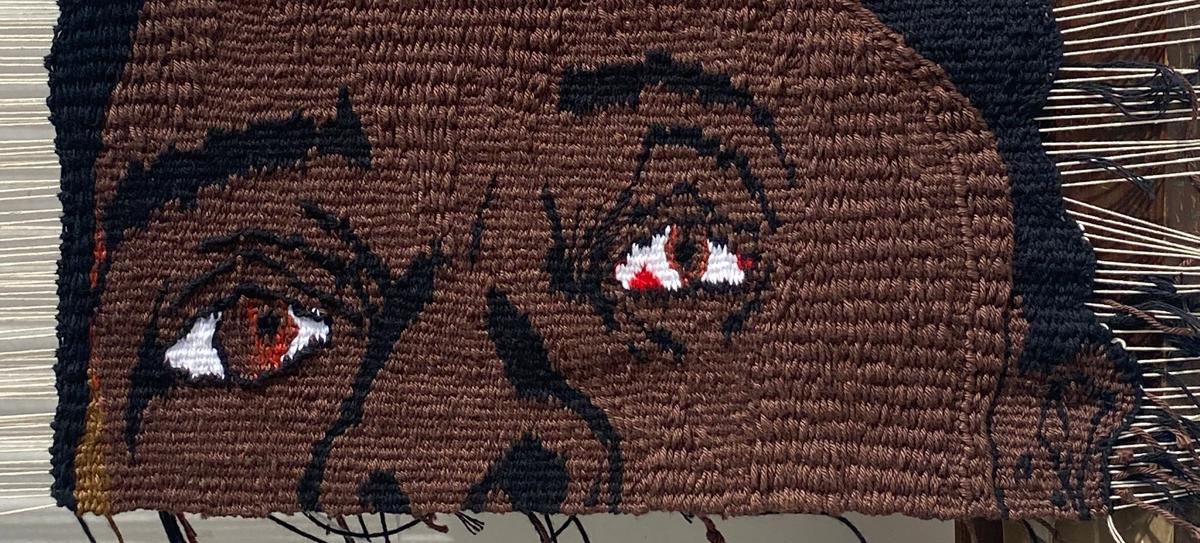
Influenced by civil rights campaigns, Greenham Common, feminist art and contemporary activism, he sees textiles as a powerful way of communicating ideas. Questions of identity also run throughout Darren’s work. A current series titled Brown Me began with a photograph of himself taken at an exhibition opening. The image became the starting point for a wider exploration of self-representation across different media.
Describing his Brown Me work, he says: “That’s on an old pub menu frame I found in a skip, so I thought I’d leave it on that. It's a huge, thick frame, and the weaving is so delicate. I like the idea of micro and macro. I've woven pieces where I've used whole items of clothing in them, but also spun hair into it.”
With the support of the CuratorSpace Artist Bursary, Darren plans to spend more time developing new experimental weaving, giving him the freedom to explore ideas, materials and processes that have been central to his practice for over three decades.
You can find out more about Darren's work at https://www.curatorspace.com/artists/Artintextilez
Featured image: Darren Calder, Brown Me, Tapestry weaving on pub menu frame, 2025
Get the latest CuratorSpace news, updates about new opportunities, upcoming deadlines, and art-related promotions.

CuratorSpace isn't another listings website; it's a place where curators and organisers can use custom online forms to allow artists to apply to their opportunity. It also allows you to see and manage all submissions made to your opportunity on the website, and to contact contributors directly.
Register now and you can start making submissions and even create your first opportunity for free.