
Royal Society of Sculptors X The Ingram Collection
Deadline: 17/11/2026City: London | Region: London | Country: United Kingdom | Eilidh McCormick
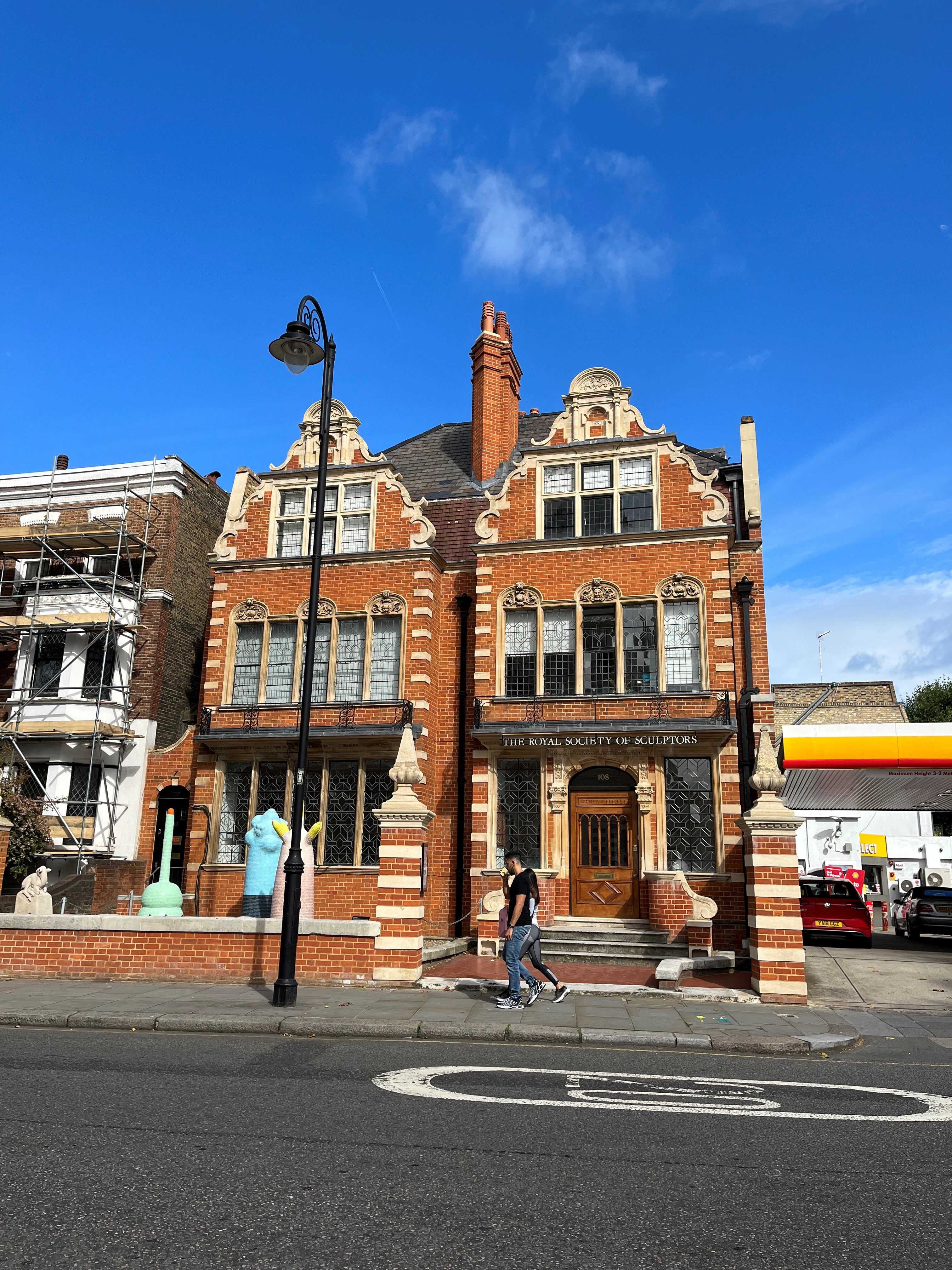
Square World | Royal Society of Sculptors and The Ingram Collection | Curated by Sarah Victoria Turner | At Dora House | Private View: Saturday 6 February 2027 | Exhibition running from 6 February, until 17 April 2027
This exhibition creates pairings and dialogues between works selected from the Ingram Collection and works submitted by fellows and members of the Royal Society of Sculptors.
To enable the dialogue between contemporary artworks from members and fellows of the Royal Society of Sculptors and the historically significant works in the Ingram collection, the submitted works need to have been completed within 5 years of the exhibition opening (from February 2022 onwards).
The work submitted must also be paired with one of the chosen Ingram collection works - more details about this will be requested in the submission form and you can see the list of artworks in the text below and in the images attached to this listing.
As well as being paired with one of the selected artworks, the artwork should additionally respond to the prompt of a ‘square world’ and the potential for dialogue – whether through concept, narrative, materials or other concerns and interests. There is more information about the theme in the text below.
About the Ingram Collection
The Ingram Collection is one of the largest and most significant publicly accessible collections of modern British art in the UK, available to all through a programme of loans and exhibitions.
Founded in 2002 by serial entrepreneur and philanthropist Chris Ingram, the majority of the collection was donated by Chris in 2016 to the Ingram Art Foundation, which was established and funded by Chris to assist in fulfilling his ambition to make such works widely available for public display.
The collection now spans over 100 years of British art and includes over 600 artworks. More than 400 of these are by some of the most important British artists of the twentieth century, amongst them Edward Burra, Lynn Chadwick, Elisabeth Frink, Barbara Hepworth and Eduardo Paolozzi.
The collection’s main focus is on the art movements that developed in the early and middle decades of the twentieth century, and there is a particularly strong and in-depth holding of modern British sculpture.
Curator
Sarah Victoria Turner
Sarah Victoria Turner is Director of the Paul Mellon Centre for Studies in British Art in London, a research institute and educational charity part of Yale University.
Sarah has overseen many innovative programmes and collaborative projects with partners in the UK and internationally, including curating Making New Worlds: Li Yuan-chia & Friends at Kettle’s Yard, co-hosting the Sculpting Lives podcast with Jo Baring, which focused on British women sculptors, and co-founding the award-winning, open-access journal British Art Studies in collaboration with colleagues at the Yale Centre for British Art.
As an art historian, much of her writing has focused on the entangled relationships between Britain, the British Empire and South Asia.
Further information on Sarah’s research and publications can be found here: https://www.paul-mellon-centre.ac.uk/about/sarah-victoria-turner.
About the exhibition | Text by Sarah Victoria Turner
Square World
The title of this exhibition is inspired by Geoffrey Clark’s Square World series of five aluminium relief sculptures (1959).
Commissioned for St Chad’s, Rubery, Birmingham, they were removed shortly after installation and before the consecration of the newly built church over a disagreement concerning the theological interpretation of the difficult-to-determine symbolism of Clark’s reliefs.
A quintet of empty plinths is all that remains of the commission at the church in Birmingham and the sculptures are now part of the Ingram Collection’s loan to the Lightbox in Woking. The title of Clark’s Square World series is the jumping off point for this exhibition.
The juxtaposition of the rigid, hard-edged geometry of the square with the fluid, roundness of the globular ‘world’ instantly suggests a certain dissonance.
It has an oxymoronic feel, of something not quite fitting, of worlds being out of kilter, of things not being entirely right. These are sentiments that are as resonant today as when Clarke named the series in the late 1950s.
Clarke left no decipher to his sculptural symbolism or the meaning of the ‘square world’ title, perhaps wishing to emphasise instead the potential of sculpture to sit in the world to embrace uncertainty, to resist easy definitions or fixed narrative.
Clark’s project was made for a particular place but his reliefs have ended up in another. Reused and reimagined, but not encountered as originally intended, the empty plinths tell their own story, as do the sculptures now displayed in a museum.
The very idea of a ‘square world’ raises lots of questions and yet offers no straightforward answers or explanations. It conjures ideas of surfaces, shapes and boundaries, of the physical and spiritual ‘edgelands’ of our world – spaces that are between one thing and another.
For the environmentalist Marion Shoard, the edgeland is the “interzone between urban and rural”, often somewhat neglected, overlooked, a place where the unexpected and surprising can often occur.
The exhibition is interested in creating conversations between historic and contemporary work that explore edgelands and interzones.
Edges can be sharp, hard and stable, but they can also be transgressed, messed up and hard to determine. What zones can we enter when we hang onto, or slip off, the edges of our square world?
Many of the works I have selected from the Ingram Collection were made by sculptors in the decades following the Second World War.
This is a particular strength of the Ingram Collection. Many of these works were made at a moment of political and social turmoil, as well as moments when new worlds were being imagined and shaped. Sculptors were experimenting materially – with the time-honoured materials of stone and bronze, but also experimenting with newly available materials and techniques.
In many of the works I have selected there is something of a sculptural shape shifting occurring, with a testing of sculpture’s vertical and horizontal limits. Political events and ideas also enter the sculptural narrative.
Many of these works have something to say about the state of the world and the human condition – sometimes through narrative force, at others more obliquely or opaquely.
I am inviting members of the Royal Society of Sculptors to respond to the prompt of a ‘square world’ and the potential for dialogue – whether through concept, narrative, materials or other concerns and interests.
Selected work from the Ingram collection
· Robert Adams, Sentinel One, Opus 390
https://ingramcollection.com/works/sentinel-one-opus-390-1979/
· Kenneth Armitage, Pandarus: variation
https://ingramcollection.com/works/pandarus-variation-1962/
· Bernard Meadows, Cock (Fountain Figure)
https://ingramcollection.com/art-focus-bernard-meadows-cock-fountain-figure-1959/
· Bernard Meadows, Study for Sculpture I
https://ingramcollection.com/works/study-for-sculpture-i-1966/
· Michael Ayrton, Maze Maker (recto); and a further study for Maze Maker (verso)
https://ingramcollection.com/works/maze-maker-recto-and-a-further-study-for-maze-maker-verso-1965/
· Michael Ayrton, Maze Music
https://ingramcollection.com/works/maze-music-1972/
· Barbara Hepworth , Granite Forms, red, yellow and deep blue
https://ingramcollection.com/works/granite-forms-red-yellow-and-deep-blue-1953/
· Elisabeth Frink, Spinning Man II
https://ingramcollection.com/works/spinning-man-ii-1960/
· William Turnbull, Strange Fruit
https://ingramcollection.com/works/strange-fruit-1959/
· George Pickard, Watchtower
https://ingramcollection.com/works/watchtower-1965/
Key notes about the opportunity
- Artists may submit up to 3 works. The entry fee is £5 per work
- Each artwork must be paired with one of the selected works from the Ingram collection - these are listed above.
- The submissions ask for installation and packaging details to assist in planning for the show, providing full information helps the curator and exhibition team.
- The artwork MUST be able to be dropped off at Dora House between 10 am and 5 pm on Monday 1 February 2027 or Tuesday 2 February 2027. You will be invited to choose a time slot and work is to be delivered and unpacked with packaging removed unless otherwise agreed in writing with the Royal Society of Sculptors. If this is not possible then your work may not be considered for the show.
- The artwork MUST be able to be collected from Dora House between 10 am and 5 pm on Tuesday 20 April 2027 or Wednesday 21 April 2027. You will be invited to choose a time slot and work is to be packed and collected promptly. Again, if this is not possible then your work may not be considered for the show.
- If work is being sent from abroad package labelling must be marked as 'Temporary import for exhibition' to avoid additional fees.
- Artists will need to supply their own plinths.
- The curatorial decision is final, no feedback will be given.
- Installation instructions must be provided in advance, if they are not already covered in the application we welcome further details via email or the instructions can be submitted via video.
- If appropriate works must be PAT tested, proof of testing will be required. If a work is not fully functioning on the day of installation it cannot be included in the show and may be removed.
- Artists will not be present for installation, experienced technicians will install work. Please provide detailed instructions if needed.
- Artwork can be for sale. Commission is 30%, please consider this when asked for the artwork sales price.
- Entry is via this online application form only.
- The closing deadline for online submission is 5 PM, Tuesday 11 November 2026. Notification of all results will be sent by email in early December
After submitting your first artwork, you will then be directed to make a payment. Select the amount for the number of submissions you would like to make.
If this is more than one, you will then be able to make further submissions by submitting additional forms up to the number of artworks you have paid for.
You can do this by clicking again on the 'Make a submission' tab.
Submission fees
The following submission fees apply to this opportunity.
- 1 artwork - 5.00 GBP
- 2 artworks - 10.00 GBP
- 3 artworks - 15.00 GBP
The appropriate fee will be payable using a debit or credit card after the first submission has been completed. If the submission fee allows you to submit more than once, you will be able to make further submissions after the first. Contact the curator if you have any questions about the opportunity or the submission fee, or email help@curatorspace.com if you have any questions about the payment process.
You must have an account to make a submission using CuratorSpace. It's free and only takes a few moments. Once registered you'll be able to keep track of all of your submissions and get updates on upcoming opportunities.
Already have an account? You'll need to log in to make a submission to this opportunity.
You must have an account to send a message to the curator of this opportunity. Registering only takes a few moments. Once registered you'll be able to keep track of all of your submissions and get updates on upcoming opportunities.
Already have an account? You must log in to send this curator a message.
Get the latest CuratorSpace news, updates about new opportunities, upcoming deadlines, and art-related promotions.

A unique opportunity for artists to show their work in a different country without having to be... Open Call: Shaping the View — Paris, October, 2026 | All media welcome
SHAPING THE VIEW explores the conditions that influence how we see, interpret and experience... Call for Interviewee - Research on Generative AI Art Practice
My name is Yudi Zhang and I am a Doctorate PGR at the University of Aberdeen seeking...